It's a place where you can find different topics for learning the Foreign English Language
martes, 3 de abril de 2018
domingo, 1 de abril de 2018
martes, 27 de marzo de 2018
domingo, 18 de marzo de 2018
miércoles, 14 de marzo de 2018
jueves, 22 de febrero de 2018
jueves, 18 de enero de 2018
martes, 16 de enero de 2018
martes, 7 de noviembre de 2017
Simple Past Tense
El tiempo Pasado Simple se usa para hablar de acciones terminadas en el pasado. Como hacen referencia a acciones que ya ocurrieron, siempre deben ir en un contexto pasado, ya sea porque se está contando una historia que ya pasó, o bien usando complementos de tiempo pasado, como:
| yesterday | ayer |
| last night | anoche |
| last week | la semana pasada |
| last month | el mes pasado |
| last year | el año pasado |
| in 1970 | en 1970 |
Comenzaremos con la conjugación del verbo to be. Para la primera y tercera persona es was, para todas las demás es were.
Lee e intenta recordar la conjugación del verbo to be en pasado.
| TO BE | |
| I | was |
| You | were |
| He | was |
| She | was |
| It | was |
| We | were |
| You | were |
| They | were |
I was in London last year. Estuve en Londres el año pasado.
Sarah and Tom were in London last year. Sarah y Tom estuvieron en Londres el año pasado.
El verbo to have en pasado es had. Es igual para todas las personas.

I had breakfast at 8 o'clock.Tomé el desayuno a las 8 en punto.
Sarah and Tom had a meeting yesterday.Sarah y Tom tuvieron una reunión ayer.
¡Ahora ponte a prueba!
Piensa y luego envía cómo dirías estas frases en inglés.Nosotros estuvimos en París el mes pasado.
Helen tomó el té a las 5 en punto.
Ellos estuvieron en el parque ayer.
Tú estuviste en la escuela esta mañana.
'''''''''''''''''''''''''''''''''''''''''''''''''''''''''''''''''''''''''''''''''''''''''''''''''''''''''''''''''''''''''''''''''''''''''''''''''''''''''''''''''''''''''''''''''''''''''''''''''''''''''''''''''''''''''''''''
Aquí te ofrecemos más verbos irregulares de uso común con su forma de pasado simple. Deberás aprenderlos de memoria!
| INFINITIVO | PASADO SIMPLE |
| buy (comprar) | bought |
| come (venir) | came |
| cut (cortar) | cut |
| drink (beber) | drank |
| eat (comer) | ate |
| feel (sentir) | felt |
| find (encontrar) | found |
| make (hacer) | made |
| put (poner) | put |
| run (correr) | ran |
| send (enviar) | sent |
| sleep (dormir) | slept |
| think (pensar) | thought |

She drank some water. Ella bebió agua.

He ate a sandwich. El se comió un sandwich.

She found a dog. Ella encontró un perro.

He cut his hair. El se cortó el cabello.
(Hay verbos neutros, que no cambian a pesar de estar en otros tiempos, como CUT, PUT, READ, entre otros)

He made a snowman. El hizo un muñeco de nieve.

He slept all night. El durmió toda la noche.
Para obtener una lista completa de verbos irregulares con sus formas de pasado simple, ver List of irregular verbs.
Para evaluar lo aprendido, dar click a cada enlace, y completar lo que se pide.
7. http://www.saberingles.com.ar/exercises/203.html
Para evaluar lo aprendido, dar click a cada enlace, y completar lo que se pide.
Any Questions, please email me, and I'll answer as soon as I can!
sábado, 14 de octubre de 2017
PARTS OF SPEECH!
In the English language, words can be
considered as the smallest elements that have distinctive meanings. Based on
their use and functions, words are categorized into several types. Every single
word we use belongs to one of ninet word groups or parts of speech. We use
thousands of words, and they can all be separated into eight groups!
We can categorize them
into 9 basic types called "word classes". It's quite
important to recognize parts of speech. This helps you to analyze sentences and
understand them. It also helps you to construct good sentences.
Parts
of Speech Table
This
is a summary of the 9 parts of speech*. You can find more detail if you click
on each part of speech.
part
of speech
|
function
or "job"
|
example
words
|
example
sentences
|
action
or state
|
(to)
be, have, do, like, work, sing, can, must
|
EnglishClub is a
web site. I like EnglishClub.
|
|
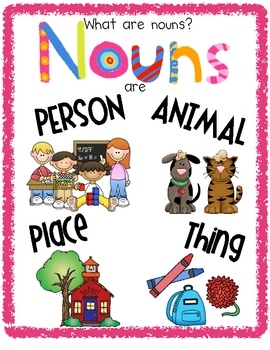
thing
or person
|
pen,
dog, work, music, town, London, teacher, John
|
This
is my dog. He lives in my house. We live in London.
|
|
describes
a noun
|
good,
big, red, well, interesting
|
My
dogs are big. I like bigdogs.
|
|
limits
or "determines" a noun
|
a/an,
the, 2, some, many
|
I
have two dogs and somerabbits.
|
|
describes
a verb, adjective or adverb
|
quickly,
silently, well, badly, very, really
|
My
dog eats quickly. When he is very hungry, he eats reallyquickly.
|
|
replaces
a noun
|
I,
you, he, she, some
|
Tara
is Indian. She is beautiful.
|
|
links
a noun to another word
|
to,
at, after, on, but
|
We
went to school on Monday.
|
|
joins
clauses or sentences or words
|
and,
but, when
|
I
like dogs and I like cats. I like cats and dogs. I like
dogs but I don't like cats.
|
|
short
exclamation, sometimes inserted into a sentence
|
oh!,
ouch!, hi!, well
|
Ouch!
That hurts! Hi! How are you? Well, I don't know.
|
Suscribirse a:
Entradas (Atom)
-
There are twenty-six (26) letters in the English Alphabet. Five (5) are vowels (a,e,i,o,u.) Tweny-one (21) are consonants (b.c.d.f.g.h.....
-
What are WH-QUESTIONS in Spanish? Click here → WH Question Words For more informations click in WH-QUESTIONS or here ➤ ...
-
AFFIRMATIVE STATEMENTS: El Presente Simple es un tiempo verbal que se utiliza para describir acciones habituales que suceden co...